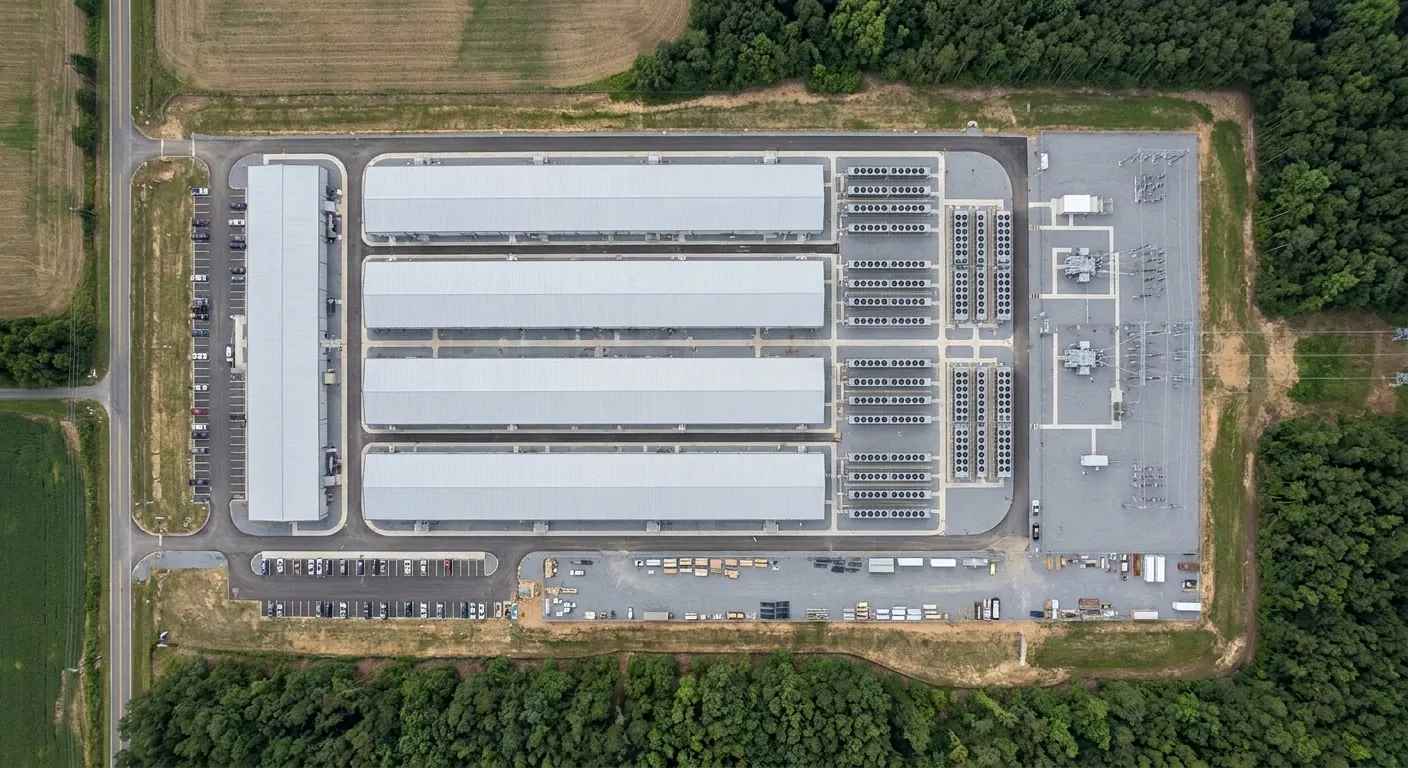
Power decides where AI gets built. This guide covers what capacity buyers should check before signing a Nordic colocation agreement.
The market has changed shape. Frontier AI labs and enterprises no longer just rent cloud instances; they sign long-dated capacity agreements with infrastructure operators. Hut 8's $7B, 245 MW, 15-year lease with Fluidstack (December 2025) and the $40B acquisition of Aligned Data Centers (October 2025) made the direction clear: operators with verified power have become the scarce asset.
For a buyer of AI capacity, that means the questions have moved upstream. The right colocation partner is no longer chosen on floor space and connectivity alone, but on power: who owns it, at what price, and with what grid rights.
What "AI-ready" actually means
A facility is AI-ready when four layers line up:
1. Grid. A contracted interconnection with physical headroom. In the Nordics, connection queues for new entrants run four to six years for sub-50 MW requests. An operator that signed its grid agreement before the queue formed holds an advantage no capital can shortcut.
2. Energy. Fixed-price renewable power. Nordic hydro trades among the lowest industrial power prices in Europe, and long-dated fixed-price structures, with Guarantees of Origin, keep the cost line flat for the life of the contract.
3. Cooling. Direct liquid cooling designed in from day one, with per-rack design loads of 120-150 kW and headroom beyond. Cold climate helps twice: free cooling most of the year, and PUE design targets of 1.08-1.15 against a European average of 1.4-1.6.
4. Operations. 24/7 monitoring, SLA-backed response, DCIM telemetry, and an operator that runs compute of its own, because nothing sharpens an operational playbook like your own hardware being on the line.
Colocation, build-to-suit or cloud?
For sustained, high-utilization workloads, owning hardware and colocating it beats cloud economics well before the end of year one. Between colocation and build-to-suit, the trade-off is speed against specificity: colocation gets you deployed in an existing hall; build-to-suit gets you a hall engineered around your cluster. Operators that offer both, on the same power position, let you start small and grow into dedicated capacity.
Frequently asked questions
What is AI data center colocation?
A hosting model where you deploy and own your GPU or HPC hardware inside an operator's facility. The operator provides power, space, liquid cooling, network and 24/7 operations under a long-term agreement. You keep the compute and its upside; the operator owns the infrastructure layer.
Why the Nordics specifically?
The lowest industrial power prices in Europe, 100% hydroelectric supply with Guarantees of Origin, natural cooling that cuts PUE overhead, and a regulatory environment positioned for EU Energy Efficiency Directive alignment.
What density should I plan for?
Current AI racks draw 120-150 kW with direct liquid cooling; next generations go higher. If a facility quotes 10-15 kW rack designs, it was built for a different era.
How fast can capacity be delivered?
That depends almost entirely on the operator's grid position. New grid applicants wait four to six years in the Nordic queue. Pure Core's first site is grid-signed, with first capacity targeted Q1 2027 and design partnerships open now.