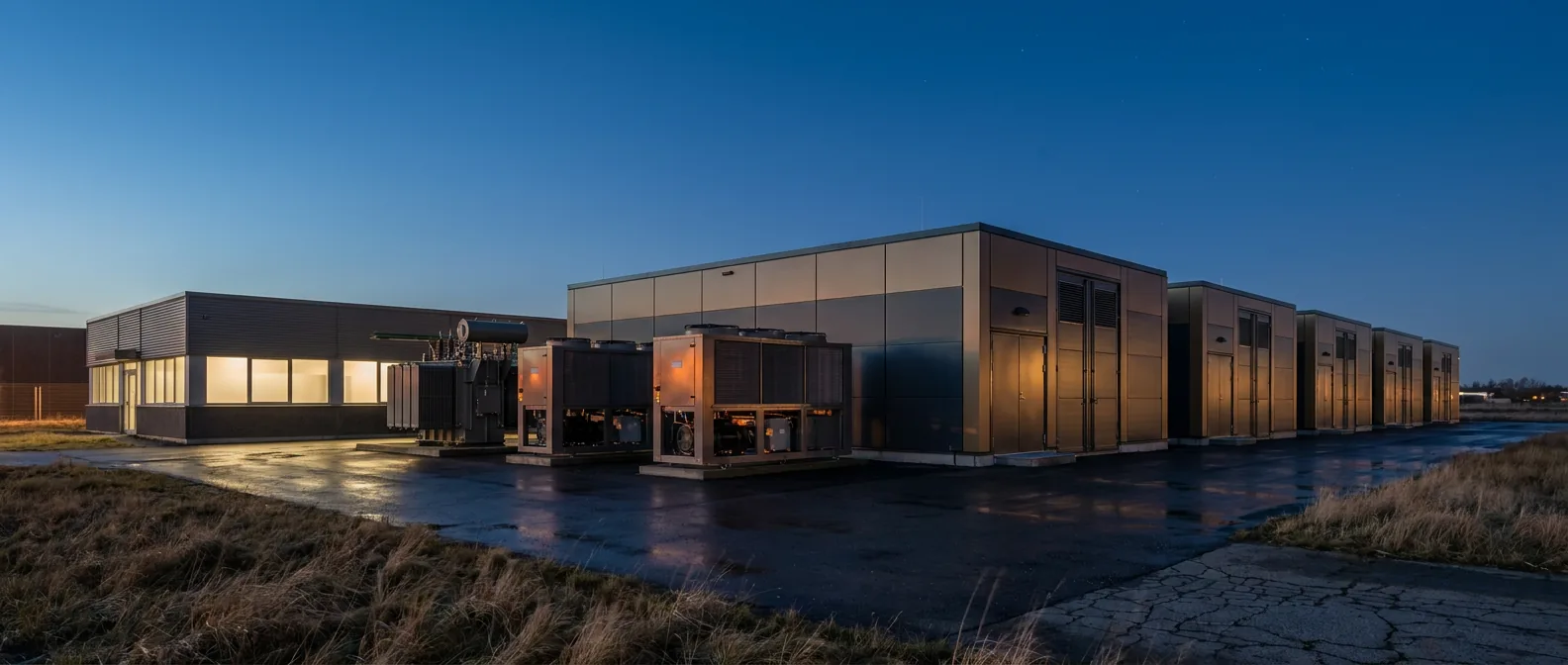
Anyone can buy GPUs. The asset that can't be replicated on demand is grid capacity.
In 2025 and 2026, the AI infrastructure market repriced. The Aligned Data Centers acquisition, at a reported $40B enterprise value by the AIP-MGX-GIP consortium (October 2025), and Hut 8's $7B, 245 MW, 15-year triple-net lease with Fluidstack, with an Anthropic anchor tenant and Google financial backstop (December 2025), told the same story from two directions: capital now treats data center operators with verified power as an institutional asset class.
The reason is a supply asymmetry that will define the rest of the decade.
Compute is abundant. Interconnection is not.
High-end GPU shipments keep growing at a double-digit rate year over year into 2027, and each hardware generation packs more compute per rack. The silicon side of the equation compounds like a technology curve.
The power side moves like heavy infrastructure, because it is. Grid connection queues in the Nordics run four to six years for sub-50 MW requests, and longer for hyperscale. US interconnection queues stretch past five years. Transformer lead times commonly run two to three years or more. Capacity additions through 2030 follow grid topology, not chip allocation.
When one input compounds and the other is queued for years, the queued input becomes the moat. Whoever holds contracted grid capacity today controls where the next wave of AI compute physically lands.
Why this favors energy-first operators
The operators winning long-dated contracts share a pattern: they secured power and grid rights first, then built the data center around them. The contract structure follows the asset: multi-year, take-or-pay capacity agreements with creditworthy tenants, a real-asset cash-flow profile underwritten by the scarcity of the underlying interconnection.
It also explains why the market pays for verified power rather than announced pipelines. A megawatt "in application" is a hope; a megawatt with a signed grid agreement is bankable.
The Nordic angle
The Nordics add an energy-cost layer on top of the scarcity story: 100% hydroelectric supply among the lowest industrial power prices in Europe, available under long-dated fixed-price structures, with cold-climate cooling pushing facility overhead toward a 1.08-1.15 design PUE. Cheap, clean, fixed-price power under a contracted grid position is the combination long-dated tenants underwrite.
Pure Core builds on exactly this thesis: an energy-first Nordic operator with grid interconnection contracted on its first site, first colocation capacity targeted Q1 2027, and a ~100 MW platform target by 2028. We monetize the bottleneck, not the chip cycle.
Quick answers
Why is grid capacity the bottleneck rather than GPUs?
GPU supply keeps growing; grid interconnection moves at infrastructure speed. Nordic queues run four to six years for new sub-50 MW requests, and transformers alone take two to three years.
What makes a data center operator "bankable"?
Verified power. A signed grid agreement plus fixed-price energy turns an operator into a counterparty that long-dated, take-or-pay contracts can be underwritten against.
Why do the Nordics stand out for AI infrastructure?
The lowest industrial power prices in Europe, 100% hydroelectric supply under long-dated fixed-price structures, and cold-climate cooling that pushes design PUE toward 1.08-1.15.